
How To Improve Knee Pain For Walking And Running
How to Improve Knee Pain for Running and Walking
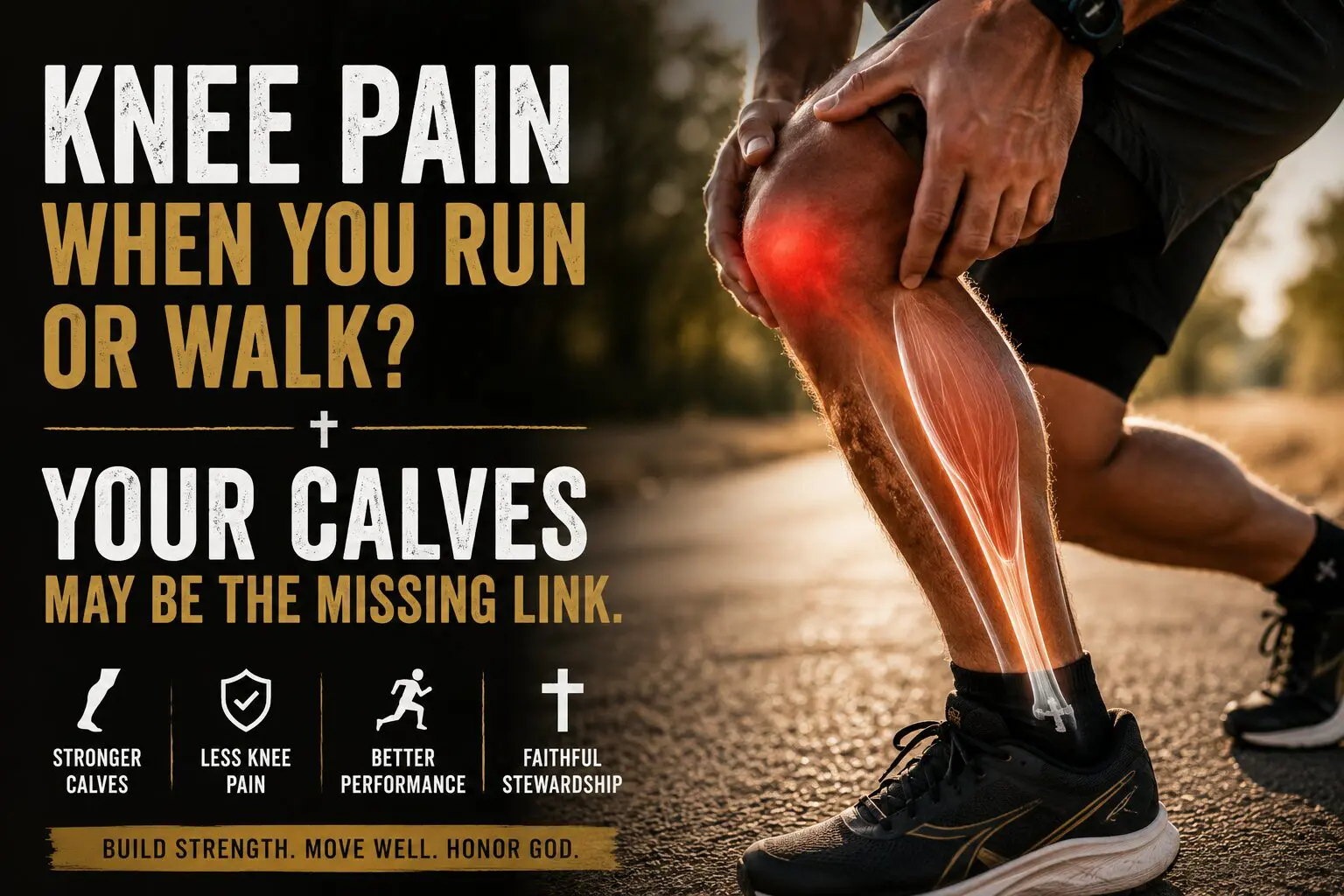
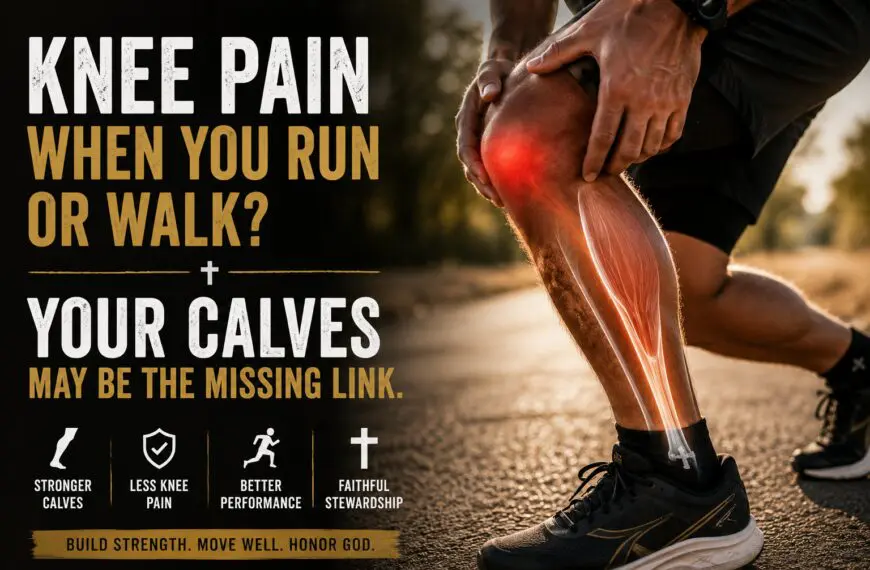
Your knee pain may not be a knee problem. If your calves are weak, stiff, or undertrained, your knees may be paying the bill every time you walk, run, climb, or train.
The knee is often where you feel the pain. But it is not always where the problem begins.
Coach Alex here. Grace and peace.
If you have knee pain when you run or walk, your first instinct is probably to focus on the knee.
You ice it.
You stretch it.
You take ibuprofen.
You buy a brace.
You stay off of it for a few days.
Then you try again.
And for a little while, it may feel better.
But then the pain comes back.
Not always sharp.
Not always dramatic.
Sometimes it is just that dull, annoying ache around the kneecap.
Sometimes it shows up after a mile.
Sometimes it shows up going downhill.
Sometimes it waits until the next morning and reminds you that your body is not moving as well as you hoped.
Here is the part most people miss:
The knee is often where you feel the pain. But it is not always where the problem begins.
One of the most overlooked contributors to knee pain in running and walking is weak, stiff, undertrained calves.
Not glamorous.
Not complicated.
But very important.
The Tension: Rest Can Calm Pain, But It Does Not Rebuild Capacity
Most people respond to knee pain in one of two ways.
They either push through it recklessly.
Or they rest until it feels better and then go right back to the same thing that irritated it in the first place.
Neither is a long-term plan.
Rest can be wise.
Rest can reduce symptoms.
Rest can calm the fire.
But rest does not automatically rebuild the house.
If your calves, feet, ankles, hips, and tendons were not prepared to absorb and redirect force before you rested, they probably will not magically be ready after a week off.
That is why pain often returns when people start running or walking again.
The irritation went down.
But the capacity never went up.
Rest may calm the fire. Training rebuilds the house.
The Science: Your Calves Are Shock Absorbers
Every step you take sends force through your body.
When you walk, your foot hits the ground and your body has to manage that impact.
When you run, the forces are higher, faster, and repeated hundreds or thousands of times.
Your body is designed for this.
But it needs the right tissues doing the right jobs at the right time.
Your calves, especially the gastrocnemius and soleus, help control what happens when your foot hits the ground.
They work with the Achilles tendon like a spring system.
The Achilles tendon stores energy.
The calf muscles control, absorb, and redirect force.
Then that system helps propel you forward.
When this system works well, your stride feels smoother.
Your foot contact feels lighter.
Your knee does not have to absorb as much of the chaos.
But when your calves are weak, stiff, or slow to respond, your knee often gets stuck paying the bill.
The body still has to move forward.
The force still has to go somewhere.
So instead of being absorbed and redirected through the foot, ankle, calf, and hip, more stress can get dumped into the knee.
That does not mean every case of knee pain is caused by the calves. But it does mean your calves deserve a serious look.
The Knee Is Often the Middleman
Think of the knee as a joint caught between two powerful neighbors.
Below it, you have the foot and ankle.
Above it, you have the hip and pelvis.
If the ankle is stiff, the knee often compensates.
If the calf is weak, the knee often compensates.
If the hip is unstable, the knee often compensates.
The knee is not usually the rebel.
It is often the servant.
It goes where the foot and hip tell it to go.
That is why simply rubbing the knee, icing the knee, or resting the knee often does not solve the issue long-term.
Those things may calm symptoms down.
But they do not necessarily change the movement pattern or capacity problem that created the irritation in the first place.
This is where training matters.
Not random exercise.
Not punishment.
Not “just push through it.”
Training.
The right dose.
The right progression.
The right tissues prepared for the work you are asking them to do.
The knee often reveals the problem, but the foot, ankle, calf, and hip often explain it.
Signs Your Calves Are Not Pulling Their Weight
Here are a few signs your calves may be underperforming in your walking or running mechanics:
- You feel knee pain when running downhill.
- You feel knee pain after increasing your walking or running volume.
- Your calves feel tight all the time, even though you stretch them.
- Your Achilles tendon, arch, or plantar fascia also gets irritated.
- You have a heavy, loud foot strike when you run.
- Your knees feel worse when you try to run faster.
- You struggle to do controlled single-leg calf raises.
- You feel like your stride is flat, stiff, or clunky.
- You avoid hills because they light up your knees.
- You feel better after rest, but the pain returns as soon as you build back up.
That last one is important.
Rest can reduce pain.
But rest does not automatically rebuild capacity.
If your calves were not strong enough to absorb and redirect force before you rested, they probably will not magically be strong enough after a week off.
Your body does not need you to panic. It needs you to listen, learn, and rebuild wisely.
A Case Study: When Rest Was Not Enough
I worked with a woman who loved the idea of running, but every time she tried to get consistent, her knee would flare up.
At first, she did what most people do.
She took ibuprofen.
That helped for a little while, but it did not fix anything.
Then she stayed off of it.
Again, it felt better at rest.
But as soon as she tried running again, the pain came back.
Then she tried to change her running form.
She watched videos.
She tried to land differently.
She tried to think about her stride, foot strike, posture, and cadence all at once.
But that only made running feel more stressful.
Now she was not just in pain.
She was confused.
By the time she reached out to Faithful Fitness, she was frustrated because she felt like her body was betraying her.
But her body was not betraying her.
Her body was communicating.
When we looked at her movement, a few things stood out.
- Her calves were tight, but not strong.
- Her ankle had limited control.
- She could do calf raises with both legs, but single-leg calf raises were shaky and short.
- Her knee was taking too much stress because her lower leg was not doing its job well enough.
So we did not start by trying to force her into perfect running form.
We started by building capacity.
We trained her calves with slow, controlled strength work.
We trained both straight-knee and bent-knee calf raises because the calf is not just one muscle doing one job.
We added foot and ankle control.
We adjusted her running volume.
We used short run-walk intervals instead of asking her to prove her toughness.
We built her up gradually.
And over time, something changed.
Her knee pain decreased.
Her stride got quieter.
Her confidence came back.
She stopped treating every run like a test she was afraid to fail.
She started seeing training as stewardship.
The goal is not just less pain. The goal is more ownership, more wisdom, more capacity, and more trust in the process.
Your Faith: Stewardship Means Listening and Building
Your body is not a machine to be abused.
It is not an enemy to be conquered.
It is not a project to obsess over.
It is a gift to be stewarded.
That means sometimes you push.
Sometimes you rest.
Sometimes you strengthen.
Sometimes you scale back.
Sometimes you stop pretending that pain is just weakness leaving the body.
And sometimes you stop using pain as an excuse to quit.
Faithful training lives in that tension.
Wisdom and grit.
Patience and courage.
Humility and effort.
If your knees hurt when you run or walk, do not just ask, “How do I make the pain go away?”
Ask better questions.
- What is my body trying to tell me?
- Where am I underprepared?
- What needs to get stronger?
- What needs to move better?
- What needs to be progressed more wisely?
- Who do I need around me to help me move forward?
Stewardship is not ignoring pain. Stewardship is learning what pain is asking you to rebuild.
The Practice: How to Train Your Calves Properly
Most people either ignore their calves completely or train them like an afterthought.
A few fast calf raises at the end of a workout is not enough if you are asking your body to run, hike, walk hills, climb stairs, or carry extra load.
You need strength.
You need control.
You need endurance.
Eventually, you need elasticity.
Practice: A Simple Calf Training Framework
1. Start with controlled calf raises.
Stand tall. Push through the ball of the foot. Rise all the way up. Pause briefly at the top. Lower slowly. Do not bounce. Do not roll to the outside of your foot. Do not rush the bottom.
Start with two legs if needed. Progress to single-leg calf raises when you can control the movement.
2. Train both straight-knee and bent-knee positions.
When your knee is straight, you bias the gastrocnemius more. When your knee is bent, you bias the soleus more.
The soleus is especially important for running and walking because it works hard when the knee is bent during stance phase.
- Straight-knee calf raises.
- Bent-knee calf raises.
- Seated calf raises.
- Wall-sit calf raises.
- Loaded calf raises when appropriate.
3. Use slow strength before bouncy work.
A lot of people jump too quickly into plyometrics. They start doing jump rope, pogos, hops, and running drills before their tissues are ready.
Earn the bounce. First build strength. Then build endurance. Then build elastic capacity.
- Pogos.
- Jump rope.
- Bunny hops.
- Short hill strides.
- Light skipping.
4. Progress walking and running like training, not punishment.
Pain often flares when people increase too many variables at once: distance, speed, hills, frequency, shoes, and running form.
That is not training. That is chaos.
- Keep the effort easy.
- Use run-walk intervals.
- Limit downhill running for a season.
- Increase volume gradually.
- Strength train consistently.
- Pay attention to next-day symptoms.
5. Stop looking for one magic fix.
The solution is rarely one stretch, one shoe, one supplement, one drill, or one form cue.
Usually, the answer is a better system: a stronger calf, a more stable foot, a better-prepared hip, a smarter running progression, and a realistic training plan.
Pain Is Information
Your body gives you feedback.
Do not ignore it.
But do not worship it either.
Pain is information.
It is not always danger.
And it is not always something to fear.
But it should make you pay attention.
Pain that is sharp, worsening, changing your gait, lingering for days, or not responding to wise training modifications should be assessed by a qualified medical professional.
That is not fear.
That is wisdom.
Do not spiritualize foolishness. Address small problems before they become bigger problems.
Final Word: Stop Guessing and Start Building
If you have been dealing with knee pain, stalled progress, inconsistent training, or confusion about what your body needs next, you do not need more random information.
You need guidance.
You need clarity.
You need wise progression.
You need someone to help you stop guessing and start training with purpose.
You do not have to keep bouncing between rest, frustration, and another failed restart.
You can build strength.
You can improve capacity.
You can learn how to move forward with patience, purpose, and faith.
With you in the work,
— Coach Alex
Join the Faithful Fitness Corps
If you are tired of guessing what your body needs next, this is exactly why we built the Faithful Fitness Corps.
Inside the Corps, you get coaching, structure, and support to help you train with wisdom instead of guesswork.
You do not have to figure it all out alone. Get the coaching you need to build strength, improve capacity, and take the next right step.