
Emotional Eating: When Food Becomes Comfort Instead of Fuel
Emotional Eating: When Food Becomes Comfort Instead of Fuel
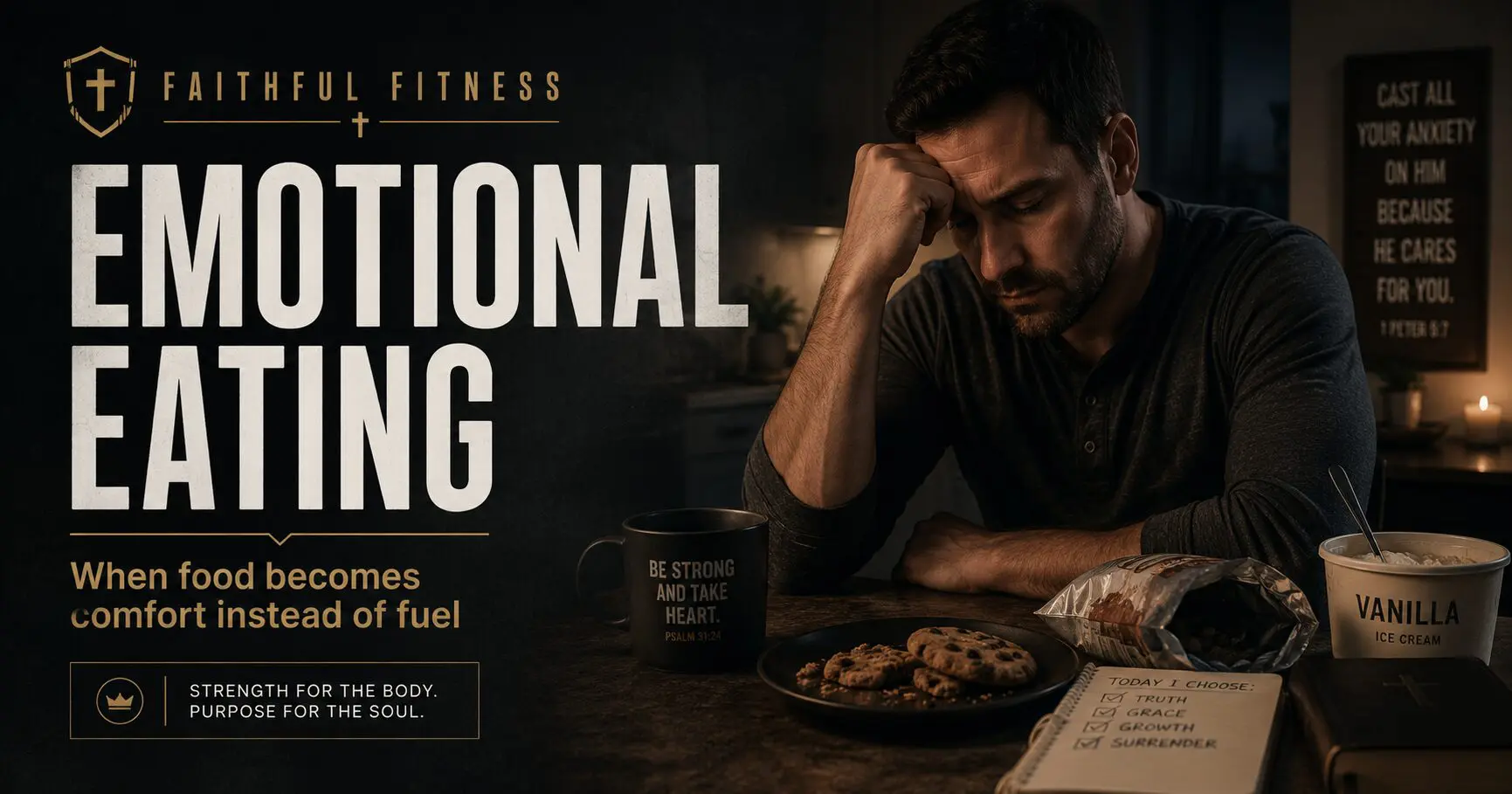
Emotional eating is not just about food. It is often about stress, comfort, unprocessed emotion, and learning how to bring your appetite back under the Lordship of Christ.
Most of us do not only eat because we are hungry. Sometimes we eat because we are tired, stressed, lonely, overwhelmed, or looking for relief.
Coach Alex here. Grace and peace.
Most of us do not only eat because we are hungry.
We eat because we are tired.
We eat because we are stressed.
We eat because the house is finally quiet and we want something that feels like ours.
We eat because we are disappointed, bored, anxious, frustrated, lonely, overstimulated, under-rested, or just plain worn thin.
And then, because we are Christians, many of us add shame on top of it.
“I should have more self-control.”
“I should be stronger than this.”
“I know better.”
Yes. Maybe you do know better.
But knowing better is not the same thing as being free.
That is one of the reasons I wrote about emotional eating in Faithful Fitness. For a lot of people, food is not the real problem.
Food is the strategy.
It is the thing we reach for when we do not know what else to do with what we are carrying.
What Is Emotional Eating?
Emotional eating is the habit of using food to manage feelings rather than to respond to true physical hunger.
That does not mean every enjoyable meal is wrong. Food is a gift from God. Celebration meals, family dinners, and shared tables are beautiful things.
But emotional eating becomes a problem when food is consistently used as escape, comfort, distraction, control, or emotional anesthesia.
In other words, the question is not simply, “Did I eat something I enjoy?”
The deeper question is:
“Am I asking food to do something for my soul that only God can do?”
The Problem: Food Becomes the Place We Go for Relief
Emotional eating usually starts honestly enough.
You have had a hard day.
You are depleted.
You are trying to get through dinner, homework, bedtime, dishes, bills, work stress, marriage stress, ministry stress, family stress, or whatever else is pressing in on you.
Somewhere in the middle of all that, your body says:
“I need relief.”
So you grab something.
Not because you prayerfully decided it would nourish your body.
Not because you were physically hungry.
But because for a few minutes, it works.
- The chips distract you.
- The cookies comfort you.
- The second bowl helps you numb out.
- The drive-thru gives you something to look forward to.
I am not saying this to shame you. I am saying this because if you do not name what is happening, you will keep fighting the wrong battle.
A lot of people are trying to solve emotional eating with stricter rules.
But rules do not heal what comfort has been covering.
The Science of Emotional Eating and Food Cravings
Your body learns patterns.
From the time you were a baby, food was connected to comfort.
When babies cry, we feed them.
And that is good. That is right. That is care.
But somewhere along the way, many of us never outgrow the pattern.
Stress rises.
Emotion rises.
Discomfort rises.
And the body remembers:
Food helps.
Not permanently.
Not deeply.
But quickly.
Highly processed foods, especially foods rich in sugar, fat, and salt, can light up reward pathways in the brain. They create a short-term sense of relief, pleasure, distraction, or control.
That is why emotional eating is so sticky.
It is not just a “bad choice.”
It is a learned loop:
- Trigger
- Craving
- Eating
- Relief
- Regret
- Repeat
And if you are exhausted, underslept, undernourished, isolated, or spiritually dry, that loop gets stronger.
This is why telling someone to “just stop eating emotionally” is usually useless. It is too shallow. It may address the behavior, but it does not address the burden underneath the behavior.
The better question is:
“What emotion am I trying not to feel?”
Or even deeper:
“What burden am I asking food to carry that it was never meant to carry?”
The Faith Aspect: Emotional Eating and the Christian Life
In Philippians 4, Paul tells us to think about what is true, noble, right, pure, lovely, admirable, excellent, and praiseworthy.
That is not motivational fluff.
That is spiritual warfare at the level of attention.
Because what you dwell on shapes what you desire.
And what you desire shapes what you reach for.
Paul is not pretending life is easy. He knew suffering. He knew hardship. He knew pressure.
But he also knew that the mind has to be trained.
You cannot let every anxious thought, every bitter thought, every fearful thought, every self-condemning thought set the table for your next decision.
Scripture says we take every thought captive to obey Christ.
That includes the thoughts that drive us to the pantry when what we really need is prayer.
That includes the thoughts that say, “I deserve this,” when what we really need is rest.
That includes the thoughts that say, “I already blew it,” when what we really need is repentance and a next faithful step.
Food is a gift from God.
But food is a terrible savior.
- It can nourish your body.
- It can bring people around a table.
- It can be enjoyed with gratitude.
But it cannot give lasting peace to your soul.
Only God can do that.
How to Stop Emotional Eating Without Shame
The goal is not to hate food.
The goal is not to become rigid, joyless, or afraid of eating something you enjoy.
The goal is stewardship.
Stewardship means bringing your body, mind, appetite, emotions, and habits back under the Lordship of Christ.
That begins with honesty.
Practice: The 10-Second Emotional Eating Pause
Here is something simple to try this week.
Before you eat outside of a planned meal or snack, pause for ten seconds and ask:
“Am I hungry, or am I looking for comfort?”
No shame. No drama. Just honesty.
If you are hungry, eat. Eat something nourishing. Eat with gratitude. Move on.
But if you are not hungry, take one more step and ask:
“What am I feeling right now?”
Name it:
- Tired
- Angry
- Lonely
- Anxious
- Overwhelmed
- Discouraged
- Bored
- Disconnected
Then do one small faithful thing before you eat:
- Drink a glass of water.
- Take a five-minute walk.
- Pray honestly.
- Text someone you trust.
- Step outside and breathe.
- Write down what is bothering you.
- Read Philippians 4:8–9 slowly.
You may still choose to eat afterward. But now you are practicing integrity.
You are no longer being dragged around by an unnamed emotion.
You are bringing your body, mind, and appetite back under the Lordship of Christ.
That is stewardship. Not perfection. Stewardship.
What Am I Really Hungry For?
If emotional eating has been part of your story, one of the most powerful questions you can ask is:
“What am I really hungry for?”
Maybe you are hungry for rest.
Maybe you are hungry for peace.
Maybe you are hungry for connection.
Maybe you are hungry for quiet.
Maybe you are hungry for encouragement.
Maybe you are hungry for forgiveness.
Maybe you are hungry for God.
When you learn to name the deeper hunger, food can return to its proper place. It becomes fuel, nourishment, fellowship, and gift.
Not escape.
Not anesthesia.
Not a false refuge.
Final Word: Food Can Comfort Briefly, But God Gives Peace
If you have struggled with emotional eating, you are not alone.
You are not uniquely broken.
You are not beyond help.
You are not disqualified from becoming a faithful steward of your body.
But you do need to stop pretending that snacks, sweets, chips, or late-night grazing can carry what only God can carry.
Food may comfort you for a moment.
God can meet you in the storm.
That is where freedom begins.
Get Your Copy of Faithful Fitness
This article is adapted from Day 8 of Faithful Fitness: A 40-Day Devotional for Health, Strength, and Stewardship.
It is not just a book about workouts. It is not just a book about nutrition.
It is a 40-day journey to help you bring your body back into alignment with your faith, your mission, and the life God has called you to live.
If emotional eating, inconsistency, shame, cravings, fatigue, or confusion have been part of your health story, I wrote this for you.
Faithful Fitness exists to help Christians steward their bodies with strength, wisdom, and worship. Train hard. Pray harder.