

Day 07 of 40 / Integrity
Your Daily Bread
Bring your hunger and attention before God.
Prepare for a prayerful fast or an appropriate nonfood practice. Make room for Scripture, seek the Father’s will, and carry your response into daily life.
Free printable + fillable PDF · 3 pages
In your book: Day 7, pages 23–25
Scripture: John 4:31–34
“Are you hungry for the right things?”
— Faithful Fitness, Day 7
A note from Coach Alex
Are you hungry for the right things?
Jesus points to the satisfaction of doing the Father’s will. Today’s companion helps you approach fasting with a clear purpose and wise care for your body.
Audio companion coming soon. You can read the coaching note below.
Read the full companion
Hey there. Coach Alex here.
Today we come to a discipline that can bring a lot to the surface: fasting. Before you decide when to start or how long to go, sit with the question in today’s devotional: Are you hungry for the right things?
In John 4, Jesus has been speaking with the woman at the well. His disciples urge Him to eat, and He tells them that His food is to do the will of the Father who sent Him. He is deeply engaged in the work God has placed before Him, including the person right in front of Him.
Food is a gift from God. Jesus taught us to ask for our daily bread. Here, He also directs our attention to a deeper hunger: the desire to do the Father’s will. Fasting gives us a deliberate occasion to bring our appetites before God and practice attending to Him.
So begin with a purpose. Perhaps you want to pray through a decision, confess a pattern you have been excusing, or become more attentive to someone God has called you to love. Write that down. When you set aside food, give the time and attention to prayer, Scripture, and obedience.
You are not purchasing God’s favor with discomfort. You are coming before Him in dependence. A longer fast does not make you a more valuable disciple, and hunger itself is not a sin. The question is what you will do with this opportunity to turn toward the Lord.
The book describes fourteen to sixteen hours for someone new to fasting and mentions twenty-four hours for a seasoned participant. Those are examples in the devotional, not a schedule that fits every body. Previous fasting experience does not remove health risks. Review the guidance on this page before choosing a food fast.
If you are under eighteen, pregnant or breastfeeding, or have a current or past eating disorder, choose the nonfood practice in the guide. If you have diabetes, take medication, are underweight or frail, or have another health condition, speak with your clinician before going without food. Do not change medication to make a fast work.
If food fasting is appropriate for you, decide your start and finish in advance. Keep drinking water; this guide does not call for going without fluids. Follow any medical fluid instructions you already have. Plan how you will return to a normal meal, and keep your ordinary responsibilities in view.
Do not treat dizziness, shaking, or unusual weakness as something you must endure to prove your faith. End the fast and seek medical advice if you feel unwell. Fainting, confusion, or chest pain require urgent medical help. If you have a prescribed plan for low blood sugar, follow it immediately.
If going without food is unsuitable, keep your meals and choose a different act of self-denial. For example, set aside optional social media for the evening and use that time to read John 4, pray, and respond to a real need. That is an alternative devotional practice, and you can participate wholeheartedly while caring for your body.
Once you have a suitable plan, give prayer a place in it. Choose a time to read John 4:31 through 34 and Matthew 6:16 through 18. In Matthew, Jesus teaches His followers to fast without making a performance for other people. Keep the purpose before God, while telling anyone who needs to know for practical support or safety.
During a food fast, ordinary hunger can remind you to pray. You might say, ‘Father, I depend on You. Help me desire Your will and respond to the work You have given me today.’ Then ask what obedience looks like in the next part of your day.
Maybe there is a conversation you have been putting off. Maybe someone needs encouragement. Maybe you need to turn away from a distraction and attend to a responsibility. Jesus’s words at the well lead us toward doing the Father’s will. Let your prayer become a concrete response.
If you are using the nonfood practice, let the moment you would usually reach for that distraction become your invitation to pray. You do not need to manufacture a dramatic feeling. Read the passage, speak honestly with God, and make room to listen.
At the end, receive your meal with gratitude and return to your usual nourishment. Reflect on what you noticed. What kept drawing your attention? What did you bring to God? What action will you carry forward? If you ended early because you felt unwell, record that honestly and seek guidance before considering another food fast.
Let’s pray. Father, thank You for daily bread and for the work You place before me. Teach me to hunger for Your righteousness. Give me wisdom to care for this body, humility to seek You sincerely, and courage to act on what You have already made clear. In Jesus’s name, amen.
Use the Fasting and Prayer Guide to prepare and reflect. For the full video devotional with me, join the CORPS. All forty video devotionals are there to support you as you continue through the book.
Bring your appetite, your attention, and your next choice before the Lord. Let’s get after it.
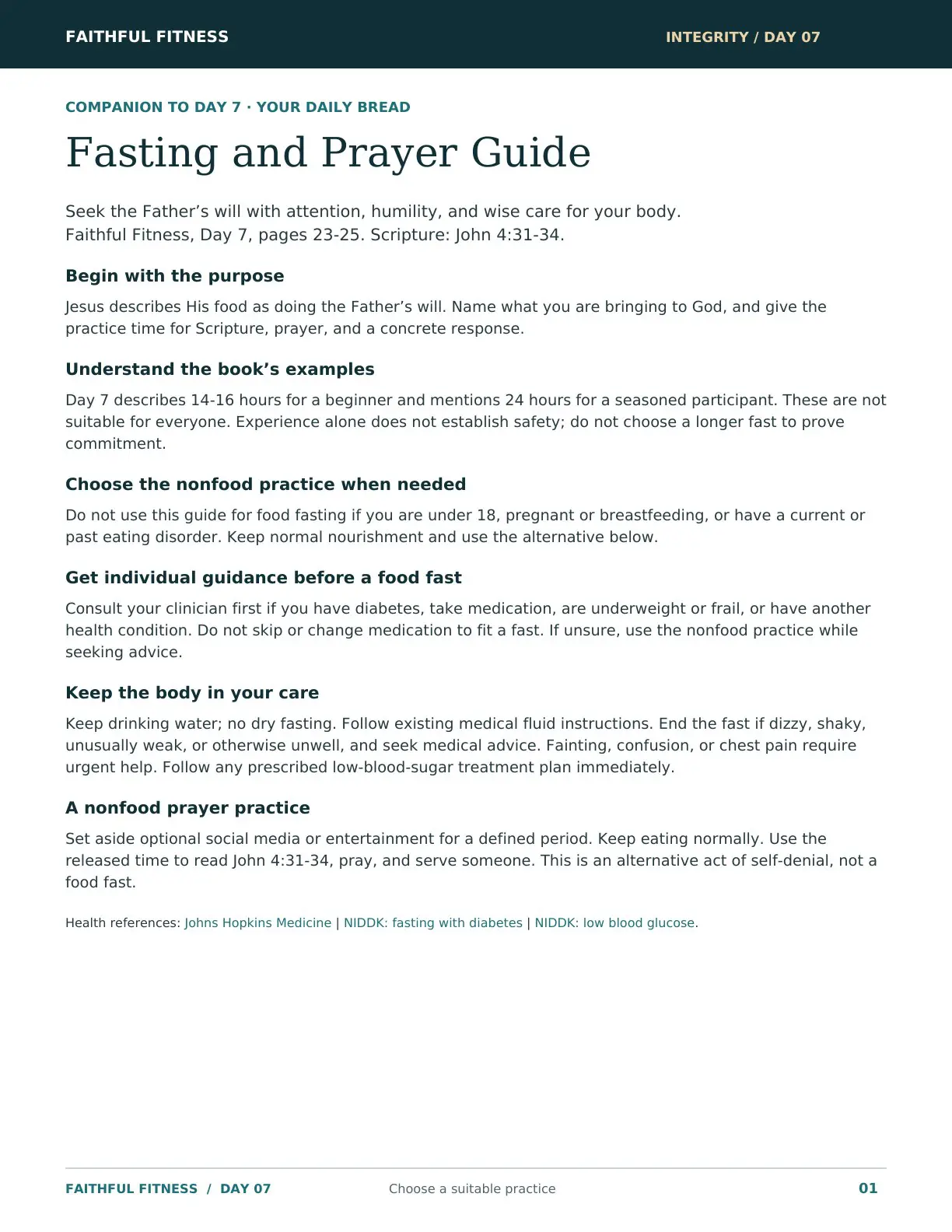
Seek the Father’s will
Give the practice a prayerful purpose.
In John 4:31–34, Jesus describes His food as doing the will of the Father who sent Him. Food remains a gift; the passage also directs us toward a deeper desire to participate in God’s work.
Name what you are bringing to God: a decision, a pattern to confess, someone to love, or a responsibility you have neglected. Give the time to Scripture and prayer, and ask what obedience looks like today.
Before choosing a food fast
Care for the body entrusted to you.
Choose the nonfood practice if you are under 18, pregnant or breastfeeding, or have a current or past eating disorder.
Ask your clinician first if you have diabetes, take medication, are underweight or frail, or have another health condition. Do not skip or change medication to fit a fast. If you are unsure, keep eating normally while you seek guidance.
Keep drinking water. This guide does not call for dry fasting. Follow any existing medical fluid instructions.
End the fast if you feel unwell. Dizziness, shaking, or unusual weakness are reasons to stop and seek medical advice. Fainting, confusion, or chest pain require urgent medical help. Follow any prescribed low-blood-sugar treatment plan immediately.
The assignment in your book
Choose a suitable plan before you begin.
Day 7 invites a fast today or tomorrow. It describes 14–16 hours for someone new to fasting and mentions 24 hours for a seasoned participant. These are devotional examples, not a universal health recommendation. Prior experience alone does not establish safety.
If food fasting is appropriate for you, decide the beginning and end ahead of time, plan prayer time, and plan your return to a normal meal. Do not extend the fast to prove commitment. The length of a fast does not measure your standing with God.
When food fasting is unsuitable
Keep your nourishment. Make room for God.
Set aside optional social media or entertainment for a defined period while continuing normal meals and medical care. Use the released time to read John 4:31–34, pray, and respond to someone’s need.
For example: “Tonight I will set aside optional scrolling after dinner. I will read John 4, pray about the conversation I have been avoiding, and decide how to approach it with truth and love.”
This is an alternative act of self-denial and prayer, rather than a food fast. You can seek God wholeheartedly while meeting your body’s needs.
Use the guide
Give prayer a place in your plan.
Prepare
Name your prayer purpose. Review whether food fasting is appropriate, choose your practice, and set a beginning and end.
Pray and respond
Read John 4:31-34 and Matthew 6:16-18. Return your attention to God and choose one concrete act of obedience.
Reflect
Receive food with gratitude. Write what you noticed, what needs care, and the next faithful action you will take.
During the practice
Return your attention to the Lord.
Read John 4:31–34 and Matthew 6:16–18. Jesus teaches fasting without seeking applause. Keep the purpose before God while sharing practical details with anyone who needs to know for support or safety.
What am I seeking?
Bring your stated prayer purpose before God. Ask whether your attention is on His will, on an outward result, or on proving something to yourself or others.
What work is in front of me?
Consider a person to encourage, a responsibility to attend to, or a conversation to approach faithfully. Let prayer lead toward a concrete response.
What if I feel distracted?
Return to the passage and pray honestly. You do not need a dramatic feeling or a new revelation to practice attention and obedience.
Receive provision with gratitude.
At the end of a suitable food fast, return to a normal meal and your usual nourishment. Reflect on what drew your attention, what you brought to God, and the action you will carry forward. Use the same reflection after the nonfood practice.
If you ended early because you felt unwell, record that honestly and seek guidance before considering another food fast. Completing the planned hours is not the purpose of this exercise.
A prayer to begin
Teach me to hunger for Your righteousness.
Father, thank You for daily bread and for the work You place before me. Teach me to hunger for Your righteousness. Give me wisdom to care for this body, humility to seek You sincerely, and courage to act on what You have already made clear. In Jesus’s name, amen.