

Day 06 of 40 / Integrity
Humble Beginnings
Small enough to repeat. Meaningful enough to matter.
Ask God for one small, meaningful shift in your stewardship. Give it a place in your day, prepare for the obstacles, and keep tending what you begin.
Free printable + fillable PDF · 2 pages
In your book: Day 6, pages 20–22
Scripture: Luke 13:18–19
“I will plant this seed and tend it daily.”
— Faithful Fitness, Day 6
A note from Coach Alex
What is your one percent better?
You have already begun several practices through the devotional. Today is a chance to choose one small step that helps you live those commitments more faithfully.
Open the Day 6 audio recording
Read the full companion
Hey there. Coach Alex here.
By now, you have committed this journey to God, pictured a stronger foundation, considered the quality of your food, practiced honesty, and begun your integrity walk. That is a lot to bring into daily life. Today, I want you to consider one small thing that would help you keep practicing what you are learning.
In Luke 13, Jesus compares the kingdom of God to a mustard seed that is planted and grows until birds can nest in its branches. He is describing God’s kingdom. In today’s devotional, we take encouragement from that picture of a humble beginning with fruit beyond what the beginning seems to suggest.
We call the application your one percent better: a small, meaningful shift you can repeat. You do not need to calculate a percentage or increase your effort every twenty-four hours. You need to identify a faithful action and give it consistent attention.
That can challenge our pride. We often want the change that looks impressive, the plan we can announce, or the fresh start that makes us feel different immediately. A small practice asks us to be honest about what we will actually do when the excitement wears off.
So ask God this question: What is one small thing I can begin, or begin doing more faithfully, that would make a meaningful difference in my stewardship? Let the answer be concrete. It may already be something you noticed in your food journal, your foundation vision, or yesterday’s walk.
Here is the difference between an intention and an action. ‘I want to eat better’ is an intention. ‘After breakfast, I will decide what vegetable I can include with dinner’ is an action. You know when it happens, and you can tell whether you did it.
‘I want to walk consistently’ is an intention. ‘After I clear my breakfast dishes, I will begin the integrity walk I planned’ gives that intention a place in your day. If the problem is getting out the door, setting your shoes where you will need them can support that practice.
Or your seed might be spiritual. Before the first bite of a meal, pause to thank God and ask Him to guide your stewardship. You are returning to His presence in a moment that already belongs to your day.
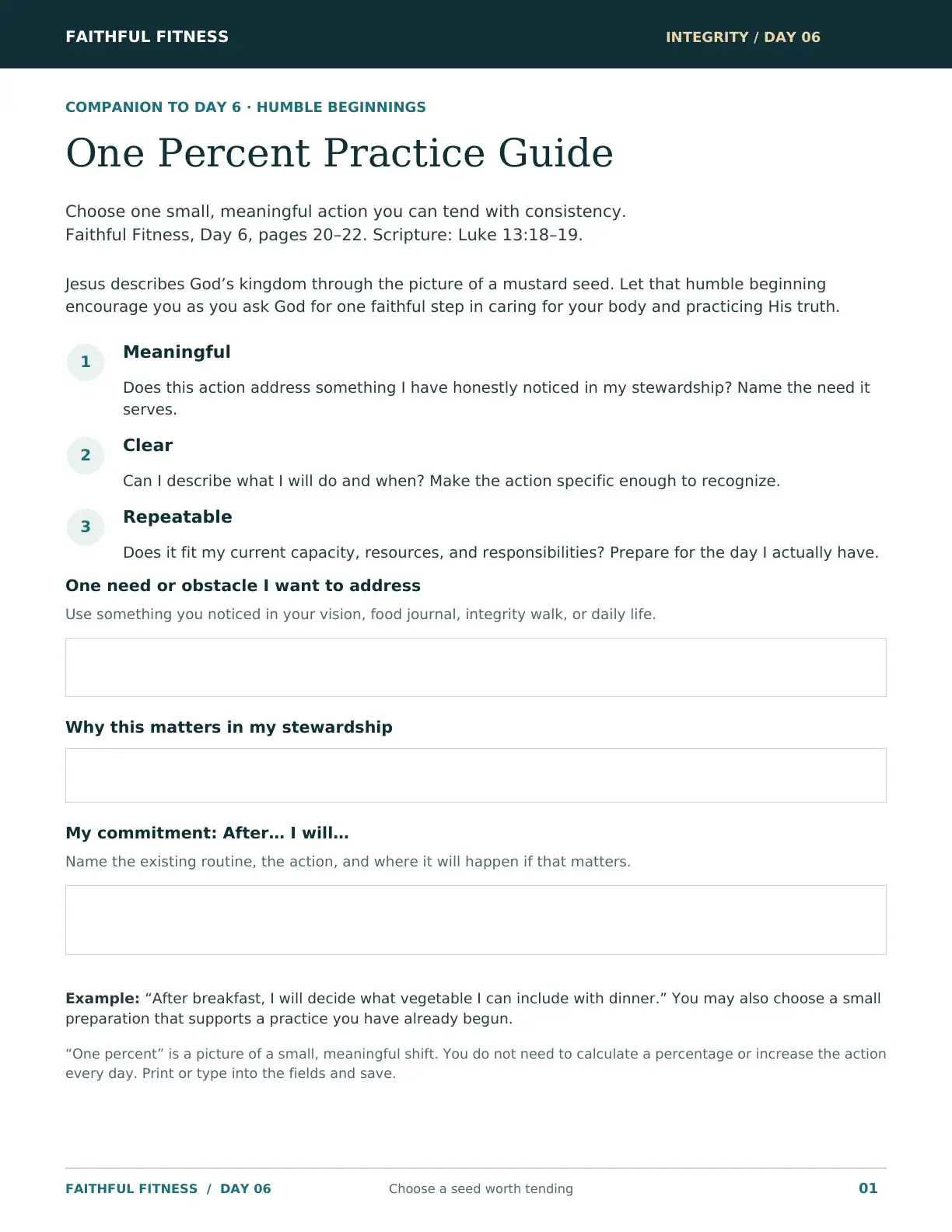
Use three questions to choose. Is this meaningful? Is it clear? Is it repeatable in my current circumstances? Meaningful means it addresses a real need or responsibility. Clear means you can describe the action. Repeatable means it fits the life and capacity you actually have.
Choose one practice to focus on. You can continue the habits you have already begun without adding a new project every day. Sometimes your one percent is preparing ahead so you can follow through on yesterday’s commitment.
And do not confuse small with careless. A small step still asks something of you. You are making a deliberate choice, keeping an honest record, and giving your attention to a responsibility you might otherwise avoid. Humility lets you begin where you are and take that beginning seriously.
Write your practice in one sentence: ‘After this part of my day, I will take this action.’ Include where it will happen if that matters. Then make one preparation now. Put the journal where you eat. Check what food is available. Place your shoes by the door. Give your intention a practical expression.
Next, consider what is most likely to interrupt it. A late meeting, a change in your health, or a family need may require an adjustment. Decide what a workable version looks like in those circumstances. If the practice cannot happen, choose the next opportunity to return.
You are not required to make the action bigger every day. Give it time to become something you actually practice. A week gives you an opportunity to review what happened; it is not a deadline for forming a habit or seeing a physical result.
At that review, ask what you practiced, what helped, and what got in the way. Did the action address the need you chose? Keep it, simplify it, or adjust the timing based on what you learn. When a practice fits and you are ready, you can prayerfully consider the next step.
The fruit may begin quietly: telling the truth sooner, preparing instead of reacting, returning after an interruption, or giving thanks where you used to rush. Notice those choices. They matter even before an outward result is visible.
Let’s pray. Father, quiet the noise around me and show me one small thing You are calling me to practice. Give me humility to begin, diligence to return, and wisdom to adjust. Help me care for this body in Your service. As good fruit grows, teach me to give You the glory. In Jesus’s name, amen.
Use the One Percent Practice Guide to choose your seed and prepare to tend it. For the full video devotional with me, join the CORPS. All forty video devotionals are there to support your journey through the book.
Choose one meaningful action. Give it a place in your day. Begin with what is in front of you. Let’s get after it.
A humble beginning
Choose a seed worth tending.
In Luke 13:18–19, Jesus compares God’s kingdom to a mustard seed that grows until birds can nest in its branches. The devotional draws encouragement from that picture: a small beginning can have significance beyond what we first see.
In your stewardship, begin with one action that serves a real need. It may be a food choice, a preparation for your integrity walk, a step toward rest, or a moment of prayer in a familiar routine.
What “one percent” means here: a small, meaningful shift you can repeat. There is no percentage to calculate, and you do not need to increase your effort every day.
Today’s assignment
Ask God where to begin. Make the answer specific.
Look at what you have already noticed in your foundation vision, food journal, or integrity walk. Choose one practice using these three questions.
Meaningful
Does this action address something I have honestly noticed in my stewardship? Name the need it serves.
Clear
Can I describe what I will do and when? Make the action specific enough to recognize.
Repeatable
Does it fit my current capacity, resources, and responsibilities? Prepare for the day I actually have.
You can keep the commitments you have already begun without adding another project every day. A small preparation that helps you follow through may be the right focus.
Turn an intention into an action
What could your one percent look like?
Choose one example to adapt, or name your own practice. Fit it to your needs, resources, and present capacity.
Nourishment
A general intention: I want to eat better.
A specific practice: After breakfast, I will decide what vegetable I can include with dinner.
Why it is useful: A small planning choice gives an intention a concrete next step.
Movement
A general intention: I want to be consistent with my integrity walk.
A specific practice: After I clear the breakfast dishes, I will begin the walk I planned.
Why it is useful: An existing routine gives the practice a specific place in the day. Adapt your walk to your capacity.
Rest
A general intention: I want to stop letting my phone extend the evening.
A specific practice: At my chosen evening reminder, I will place my phone on its charger away from where I wind down.
Why it is useful: The action addresses a specific obstacle to the rest you intended to receive.
Spiritual attention
A general intention: I want to remember God in my food choices.
A specific practice: Before the first bite of a meal, I will pause to thank God and ask for His guidance.
Why it is useful: A moment already in your day becomes a place to practice attention and gratitude.
Give the action a place in your day
After this routine, I will take this step.
Finish that sentence with something you can recognize. Name where the action will happen if that matters. Then make one preparation today: check available food, place your journal where you eat, or set out what you need for your walk.
Consider a likely interruption and choose a workable adjustment. If the action cannot happen, identify the next opportunity to return. Let the plan fit the responsibilities and capacity you actually have.
Tend it long enough to learn
Practice, then review honestly.
Set a review date after one week. Ask: What did I actually practice? What helped? What got in the way? Did the action address the need I chose?
Keep it, simplify it, or adjust the timing based on what you learn. A week is a useful review point, not a deadline for forming a habit or seeing a physical result.
Notice the quieter fruit, too: preparing instead of reacting, telling the truth sooner, giving thanks, or returning after an interruption. You can acknowledge those choices while continuing to grow.
Pray, then plant the seed
Begin with what is in front of you.
Father, quiet the noise around me and show me one small thing You are calling me to practice. Give me humility to begin, diligence to return, and wisdom to adjust. Help me care for this body in Your service. As good fruit grows, teach me to give You the glory. In Jesus’s name, amen.
Use the guide to name your practice, make one preparation, and plan how you will return when life interrupts. Take the first step today.
An optional next step
Need help choosing where to focus?
Explore the Faithful Fitness Health and Habits Profile as you consider your everyday patterns. Bring what you notice back to the guide and choose one meaningful practice to begin.