

Day 03 of 40 / Integrity
Muddy Bricks
See the nourishment in your food.
Food provides the energy you use and materials your body needs to maintain and repair itself. Learn what comes with each bite, then make one thoughtful choice with what you have.
Free printable + fillable PDF · 4 pages
In your book: Day 3, pages 11–13
Scripture: 1 Corinthians 6:18–20
“Every time you are about to eat or drink today, pray and ask God whether this is the best you can do right now.”
— Faithful Fitness, Day 3
A note from Coach Alex
What are you building with?
A calorie number describes energy. It does not tell you everything about the nourishment a food offers. Let’s look at the materials God has provided and how you can use them with greater intention.
Open the Day 3 audio recording
Read the full companion
Hey there. Coach Alex here.
Today I want you to look at your next meal a little differently. In Day 3, Muddy Bricks, we talk about the materials you're using to care for the body God has entrusted to you. Calories tell you how much energy a food provides. There's a whole lot more happening on that plate.
Your body is constantly maintaining and repairing itself. Food supplies fuel for that work and materials the work requires. As you learn to see those things, you can make a more thoughtful choice with the food that's available to you.
Let's start with carbohydrates, protein, and fat. You'll hear these called macronutrients.
Carbohydrates are a major source of energy. Your body breaks down sugars and starches into glucose, which your cells use as fuel. Oats, potatoes, fruit, rice, and beans can all contribute. Fiber is also a carbohydrate, and it supports digestion in ways that are different from sugar and starch.
Protein supplies amino acids. Your body uses them to build and repair tissue, and to make things like enzymes and antibodies. Think beyond your biceps. We're talking about the working parts of your body.
Fats provide concentrated energy and contribute to cell membranes. They also help you absorb certain vitamins. Olive oil, nuts, avocado, and salmon bring fat into a meal in different ways.
Those are useful starting roles to remember. All three can supply energy, and their jobs overlap. Most foods contain a combination. Beans bring carbohydrates and protein. Eggs bring protein and fat. Food doesn't fit neatly into just one box.
Now let's clear up two words that can sound like opposites: nutrient dense and energy dense.
Nutrient density asks how much useful nutrition a food brings relative to its calories. Energy density describes how many calories are packed into a given weight of food. Something can be rich in nutrients and concentrated in energy. Nuts are a good example.
If you're looking for nutrient-rich protein foods with relatively little fat, think skinless chicken or turkey breast, white fish, lean cuts of meat, or plain low-fat Greek yogurt. They let you get substantial protein without as much energy from fat.
Protein-containing foods that tend to be more energy dense include cheese, higher-fat ground beef, sausage, nuts, and nut butters. The extra energy often comes from fat. Their nutritional value differs, so that list isn't a verdict on whether you should eat them.
Take fish. Cod and salmon both provide protein. Salmon generally brings more fat and energy for the same cooked weight, along with valuable omega-three fats. Choosing salmon can be an excellent way to nourish yourself. You simply want to understand what it contributes.
Or consider peanut butter. It contains protein, but most of its calories come from fat. Enjoy it for what it offers. It doesn't provide the same balance of protein and energy as a serving of chicken or plain Greek yogurt.
The guide on this page gives you more examples. Use them to choose foods and amounts that fit what you need. Sometimes you need more fuel. Sometimes you want more protein without much additional energy. A useful food choice starts with understanding the difference.
There's still more on the plate. Vitamins and minerals help your body do the work God designed it to do. Vitamin C helps you make collagen. Iron is needed for the protein in your blood that carries oxygen. Calcium helps maintain bones and supports muscle function. None of those jobs shows up in a calorie number.
Plant foods also contain compounds called phytonutrients. That includes carotenoids in orange vegetables and polyphenols in berries. These aren't all essential nutrients in the same sense as vitamins and minerals, but they are part of the broader picture scientists study when they look at food and health.
Look at an orange. You get carbohydrate energy, water, fiber, vitamin C, and plant compounds together. A regular orange-flavored soda provides energy from sugar, but little of that other nourishment. Calling both of them carbs misses a lot.
Preparation matters too. A plain baked potato and potato chips both start with a potato. Chips contain less water and more fat, so more energy fits into the same weight. The form of the food changes what you're getting.
Convenience can still support good nutrition. Frozen vegetables, canned beans, plain yogurt, and tofu can all be useful building materials. You don't need an expensive grocery cart or an all-or-nothing food rule to begin practicing stewardship.
Picture a bowl with chicken or tofu, rice and beans, peppers, and some avocado. The protein supports repair. Rice and beans supply carbohydrate energy. Beans and vegetables bring fiber and other nutrients. The avocado contributes fat. Several ingredients do more than one job.
You can build that understanding into a meal your family already eats. Add beans to the rice. Put frozen vegetables beside the chicken. Include a protein food with breakfast. Choose one change that improves the nourishment you actually get.
In First Corinthians six, Paul reminds believers that our bodies belong to God. Today's chapter applies that call to how we feed ourselves. Before you eat or drink today, pause and pray. Ask whether this is the best you can do right now with what you have. That's the assignment.
Use the final page of the guide to think through one meal. What will give you energy? Where is the protein? What else comes with those foods? Then choose a practical improvement. Your time, budget, preferences, and individual needs belong in that decision.
For the full video devotional with me, join the CORPS. And if you'd like a broader look at your habits across Integrity, Grit, Growth, and Awe, you'll find the Faithful Fitness Health and Habits Profile linked on this page.
Let's pray. Father, thank You for our daily bread and for the bodies You've entrusted to us. Teach us to recognize the nourishment You've provided. Give us wisdom to use what we have well and humility to keep learning. Let the care we take with our bodies help us serve You and the people You've given us to love. In Jesus' name, amen.
Let's get after it.
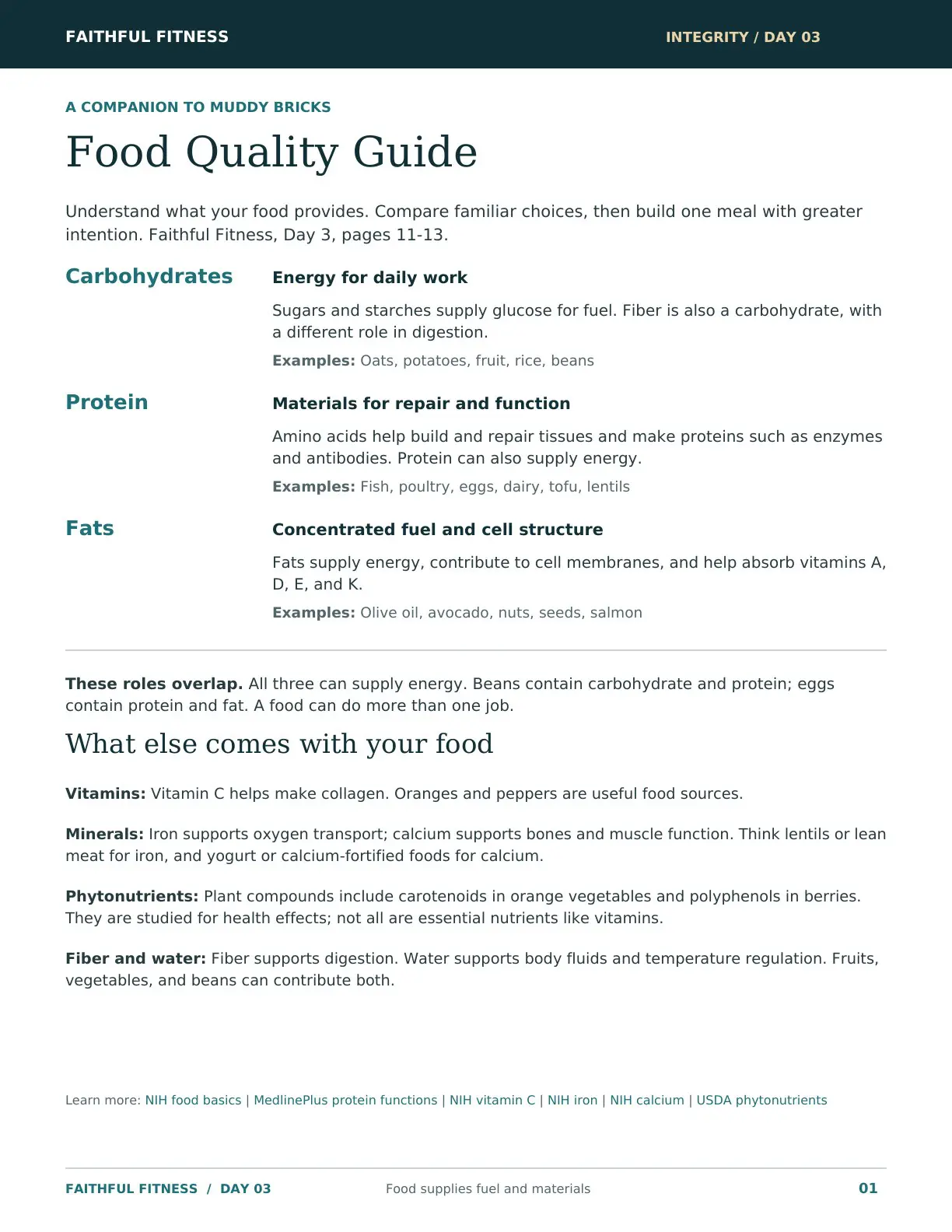
Understand the building materials
Food has several jobs to do.
Carbohydrates
Energy for daily work
Sugars and starches supply glucose for fuel. Fiber is also a carbohydrate, with a different role in digestion.
Examples: Oats, potatoes, fruit, rice, beans
Protein
Materials for repair and function
Amino acids help build and repair tissues and make proteins such as enzymes and antibodies. Protein can also supply energy.
Examples: Fish, poultry, eggs, dairy, tofu, lentils
Fats
Concentrated fuel and cell structure
Fats supply energy, contribute to cell membranes, and help absorb vitamins A, D, E, and K.
Examples: Olive oil, avocado, nuts, seeds, salmon
The roles overlap. All three can provide energy. Most foods contain a mixture: beans bring carbohydrate and protein; eggs bring protein and fat. Learn what each food contributes.
Vitamins, minerals, and more
What else comes with your food?
Vitamins
Vitamin C helps the body make collagen. Oranges and peppers are everyday sources.
Minerals
Iron supports oxygen transport; calcium supports bones and muscle function. Lentils, lean meat, yogurt, and calcium-fortified foods contribute different minerals.
Phytonutrients
Plant compounds include carotenoids in orange vegetables and polyphenols in berries. They are studied for health effects; not all are essential nutrients like vitamins.
Fiber and water
Fiber supports digestion. Water supports body fluids and temperature regulation. Fruits, vegetables, and beans can contribute both.
Two different measures
Dense in what?
Nutrient density
How much useful nutrition a food supplies relative to its calories. Consider vitamins, minerals, protein, fiber, and other food components.
Energy density
How many calories are packed into a given weight of food. More fat and less water generally make energy more concentrated.
A food can be both. Nuts provide nutrients and concentrated energy. Nutrient density does not mean “as few calories as possible.” Energy needs and the contribution of the whole food both matter.
Protein examples you can use
Notice what comes with the protein.
Nutrient-rich, leaner protein choices
Skinless chicken or turkey breast, white fish, lean cuts of meat, and plain low-fat Greek yogurt. These offer substantial protein with relatively little fat.
More energy-dense protein foods
Cheese, higher-fat ground beef, sausage, nuts, and nut butters. Fat contributes much of the additional energy. These foods differ in nutritional value; compare what each brings.
Cod and salmon show why the distinction matters. Both provide protein. Salmon generally contains more fat and energy for the same cooked weight, along with omega-3 fats. More energy does not make it a poorer choice.
Skinless poultry, white fish, lean meat
Protein with relatively little fat; different choices supply different vitamins and minerals. Useful when you want substantial protein with less energy from fat.
Plain low-fat Greek yogurt
Protein and calcium; the amount of fat varies by product. Usually less energy per gram than hard cheese. Check the label.
Salmon and whole eggs
Protein plus fat. Salmon supplies omega-3s; eggs supply choline. More energy than comparable leaner options, with useful nutrients of their own.
Beans, lentils, tofu
Beans and lentils combine protein, carbohydrate, and fiber. Tofu provides protein and fat. Plant foods contribute in different ways. Amounts and preparation matter.
Cheese, nuts, nut butters
Protein together with substantial fat. Cheese offers calcium; nuts also provide fiber. Concentrated energy. Nut butters supply most of their calories as fat.
Sausage, higher-fat ground beef, fried breaded chicken
Protein with more fat; breading adds starch. Many products also contain substantial sodium. Usually more energy than leaner, unbreaded versions. Compare similar amounts.
Food amounts, brands, and preparation vary. For a fair label comparison, compare similar amounts. More protein per calorie describes protein concentration; it is not a complete score for food quality.
Look past the macro label
Compare familiar foods.
Whole orange / regular orange-flavored soda
Both provide carbohydrate energy. The orange also brings fiber, vitamin C, water, and plant compounds. Typical soda adds sugar energy with little of that nourishment.
Plain baked potato / potato chips
Both begin with potatoes. Chips have less water and added fat, making them more energy dense by weight. Preparation changes the balance.
Plain oats / sweetened granola
Both can provide whole grains and fiber. Added oil and sweeteners often make granola more energy dense. Ingredients and portions vary.
Olive oil / avocado or nuts
All can contribute unsaturated fats. Oil concentrates the fat; whole avocado and nuts also provide fiber and other nutrients. They serve different purposes in a meal.
Put the pieces together
One bowl with several jobs.
Chicken or tofu + rice and beans + peppers + avocado
The chicken or tofu contributes protein. Rice and beans provide carbohydrate energy; beans also bring protein and fiber. Peppers contribute vitamin C and other plant compounds. Avocado adds fat and fiber. Several ingredients do more than one job.
Adapt a meal you already eat. Add beans to rice, put frozen vegetables beside the chicken, or include a protein food with breakfast. Adjust amounts and ingredients to your needs and what is available.
Today’s practice
Choose with gratitude and intention.
Before each meal or drink today, pause and pray. Ask whether this is the best you can do right now with what you have. Use the final page of the guide to think through one meal and choose a practical improvement.
Father, teach me to recognize the nourishment You have provided. Give me wisdom to use what I have well. Let my care for this body help me serve You faithfully. In Jesus’ name, amen.
See your habits more clearly
Take a broader look at your foundation.
Nutrition is one part of how you care for your body. Explore the Faithful Fitness Health and Habits Profile to reflect on your habits across Integrity, Grit, Growth, and Awe.