

Day 04 of 40 / Integrity
Nutritional
honesty
Start with what you actually eat.
Today, bring your everyday food choices into the light. Keep a simple record of what you eat and drink, then use it to learn how to care for the body God has entrusted to you.
Free printable + fillable PDF · 3 pages
In your book: Day 4, pages 14–16
Scripture: Matthew 15:18–20
“Record everything you eat and drink today—and for the rest of these forty days—not to shame yourself but to steward the temple well.”
— Faithful Fitness, Day 4
A note from Coach Alex
Make room for an honest picture.
Jesus brings our attention back to the heart. As you begin this practice, ask what you have made complicated and what you have been reluctant to see. An ordinary, truthful entry gives you a place to begin.
Open the Day 4 audio recording
Read the full companion
Hey there. Coach Alex here.
Today we're talking about nutritional honesty. And before you decide that means you need another app, a food scale, or a whole new meal plan, take a breath. You can start with a pen and a piece of paper.
In today's passage, Jesus is confronting religious leaders who are focused on washed hands while overlooking what's happening in the heart. He brings their attention back to the things that actually need to change. That's the invitation I want you to hear today. Where have I made food complicated while avoiding something I already know needs attention?
Maybe you've spent a lot of time debating which bread is best, but you regularly get through most of the day without sitting down to eat. Maybe you've convinced yourself the little bites don't count. Maybe you eat pretty consistently, and you need an honest record that helps you recognize what you're already doing well.
We don't have to guess. We can write it down.
Your assignment in the book is to record everything you eat and drink today, and to keep that practice going through the rest of these forty days. Let me help you make that simple enough to actually do.
Choose one place for your record. There's a journal you can download on this page, or you can use a notebook or a note on your phone. Pick the one you'll have with you when you're eating.
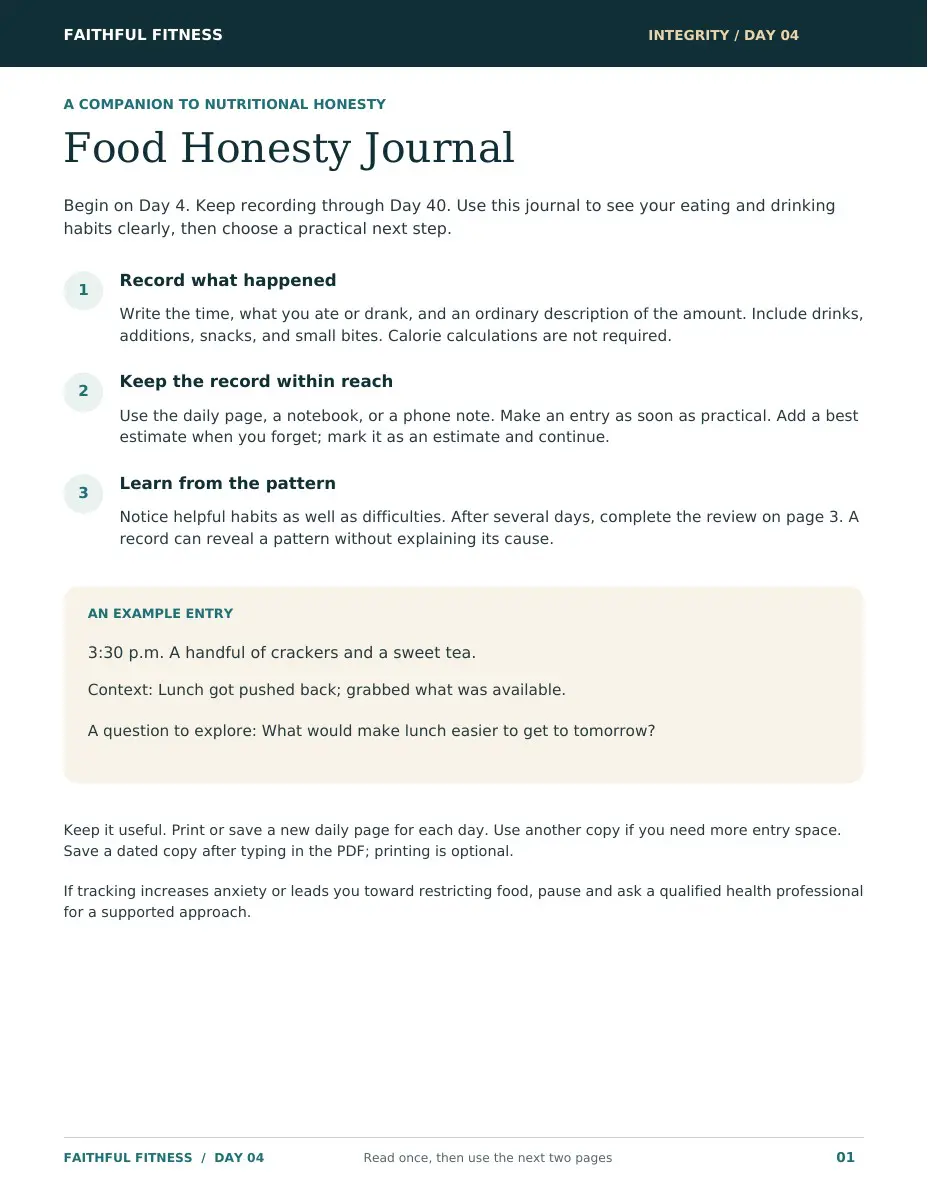
Each time you eat or drink, record roughly when it happened and what you had. Include an ordinary description of the amount: a mug, a sandwich, a handful, a second helping. You don't need to calculate calories for this exercise. If you forget something, add what you remember and keep going. An honest estimate is useful.
Include the things that are easy to leave out: the creamer in your coffee, a drink in the car, a few bites while you're cooking, or what you finished from a child's plate. You don't have to defend the entry. Just make it.
If it's helpful, add a few words about what was going on around the meal. Were you hungry? Rushed? Eating with friends? Had you gone a long time without food? That little bit of context can help you ask a better question later. You can leave it blank when you don't know.
Here's a made-up example. At three thirty, you write: a handful of crackers and a sweet tea. Under context, you write: lunch got pushed back; grabbed what was available. That's a useful entry. It gives you something concrete to work with. Maybe your next step is making lunch easier to get to. You can explore that without turning one afternoon into a verdict on your character.
And please don't stop recording because a meal didn't go the way you planned. The moments you're tempted to leave out are often the moments you most need help understanding. Keep them in the picture.
At the end of today, take a minute to look back. What supported you? What surprised you? Thank God for one thing you were able to notice honestly. Then make the next entry tomorrow.
After several days, use the review page to look for something that repeats. Keep your first change small enough to practice in your real life. For example: when I check tomorrow's schedule, I'll set a reminder to take my lunch break. A clear action tied to something you already do is easier to remember than a vague promise to eat better.
A journal can show you a pattern. It won't always explain the cause. That's one reason the book encourages you to share your record with a professional you trust. You can bring questions along with it: here's what I'm seeing; can you help me understand where to begin?
If tracking makes you increasingly anxious or leads you toward restricting food, pause and ask a qualified health professional for a supported approach. You can practice honesty while getting the help you need.
And if you'd like my help turning what you're noticing into practical next steps, you'll find Jumpstart coaching linked on this page. For the full video devotional with me and ongoing support in the Faithful Fitness community, join the CORPS. Those doors are open when you're ready.
For today, start with your next meal or drink. Write down what happened. Bring your real life before God, and be willing to learn.
Let's pray. Father, thank You for the body You've entrusted to me. Help me see my habits clearly. Give me the humility to receive help and the courage to act on what You show me. Teach me to care for this body faithfully, for Your glory and the good of the people You've given me to love. In Jesus' name, amen.
Let's get after it.
Today’s practice
Begin with your next meal or drink.
01
Choose one place
Download the journal, open a phone note, or use a notebook. Keep it where you can reach it when you eat.
02
Record each meal and drink
Write roughly when, what, and how much in everyday terms. Include additions and small bites. Context is optional.
03
Review and keep going
Notice one thing tonight. After several days, look for a pattern and choose one practical action. Continue through Day 40.
Here’s what an entry can look like
3:30 p.m.
A handful of crackers and a sweet tea.
Context
Lunch got pushed back; grabbed what was available.
A question to explore
What would make lunch easier to get to tomorrow?
Describe what happened before deciding what it means. One entry gives you a question; several days may reveal a pattern.
What if I forget an entry or don’t know the amount?
Write your best estimate, label it as an estimate, and continue. Use ordinary amounts such as a bowl, a mug, or a handful. Keep the record useful enough to learn from. You do not need to restart the forty days.
Do I need to calculate calories?
No. Today’s assignment is to record what you eat and drink. If you already follow a plan from a qualified professional, keep following that guidance.
What if tracking makes me anxious?
Pause if tracking increases anxiety or leads you toward restricting food. Ask a qualified health professional for a supported approach. If you are receiving care for an eating disorder, follow your treatment team’s guidance.
Bring it to God
What am I willing to see?
Where do I explain away a habit before taking an honest look at it? What might become possible if I brought that habit into the light with someone I trust?
Father, help me see my habits clearly. Give me humility to receive help and courage to practice the next faithful step. In Jesus’ name, amen.
Turn what you notice into action
Want help choosing your next step?
The book encourages you to share your record with a professional you trust. If you would like personal coaching as you work on your habits, explore Jumpstart with Coach Alex.